AMI-300
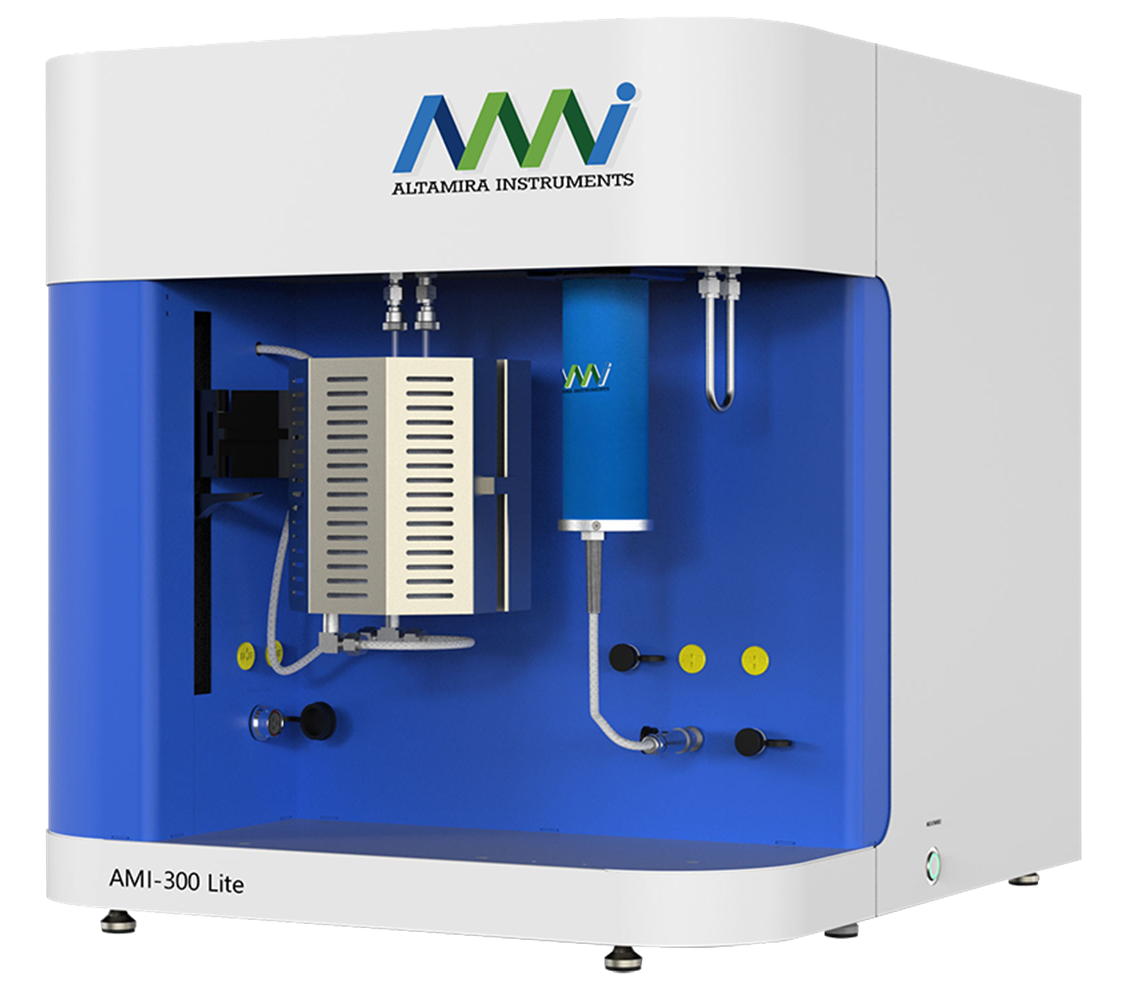
AMI-300 Series Chemisorption Analyser
The AMI-300 is a fully automated chemisorption analyser that can be used to perform dynamic temperature-programmed experiments to characterise catalytic surface activity.
It can perform pretreatment of catalysts, followed by analysis such as temperature-programmed desorption (TPD), temperature-programmed oxidation (TPO), temperature-programmed reduction (TPR), and temperature-programmed reaction (TPRx).
The AMI-300 can also perform pulsed chemisorption and single point BET surface area measurement.
Such experiments are useful in evaluating the performance of catalysts such as percentage of metal dispersion, temperature which the metals become catalytically active, strength of active sites, activation energy of desorption and many more.
Experimental conditions are fully programmable and up to 99 consecutive treatments and/or analyses procedures can be linked together into one experimental sequence for completely unattended operation.
Heat-traced stainless steel flow paths eliminate the risk of condensation, ensuring that all eluents are preserved in the gas phase for detection.
The sub-ambient option allows the furnace to linearly heat the catalyst sample from -130 to 1,200°C. This is useful for catalysts that are active at sub-ambient temperatures.
The system comes with gas blending capabilities that avoid the need to purchase expensive gas blends for TPR or TPO experiments. An auxiliary gas line allows a gas to be mixed with the carrier gas to provide custom-blended gases. An inline static gas mixer assures homogeneity of the resulting blend.
The AMI-300 can be coupled to an auxiliary detector such as a mass spectrometer or FID detector to analyse off gas. Data from auxiliary detectors can be integrated with AMI-300 data in real-time using Direct Data Exchange (DDE) or other Windows protocols.
The AMI-300 is a versatile platform that can be customised to perform advanced catalyst characterisation, such as:
SSITKA
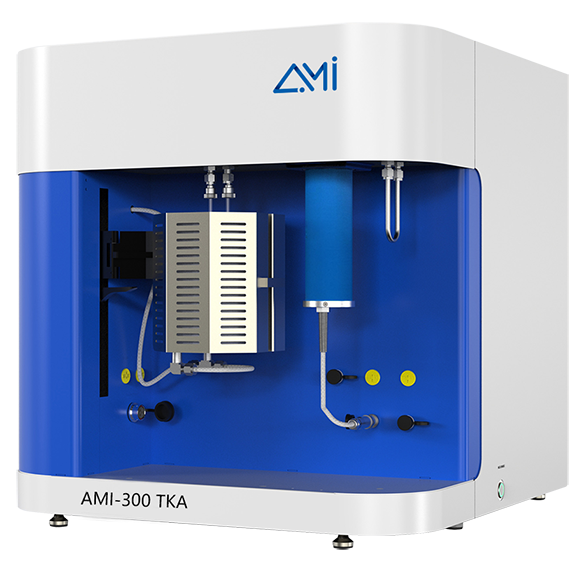
AMI-300 SSITKA
The AMI-300 SSITKA is configured to perform an additional Steady-State Isotopic Transient Kinetic Analysis (SSITKA) functionality, enabling in-depth investigation of catalytic reaction pathways, intermediate lifetimes and surface kinetics.
This is achieved through precise pressure equalisation, allowing for rapid and accurate isotopic switching under steady-state reaction conditions.
With SSITKA, users can directly quantify the amount of reaction intermediates on the catalyst surface, determine their surface residence time(
By monitoring how long intermediates remain on the surface and how these values change with reaction time or conditions, SSITKA provides critical insights into catalyst performance. It helps identify which active sites are contributing most significantly to the reaction, pinpoints rate-limiting steps and explains potential causes for decreased catalytic activity over time.
AMI-300 IR
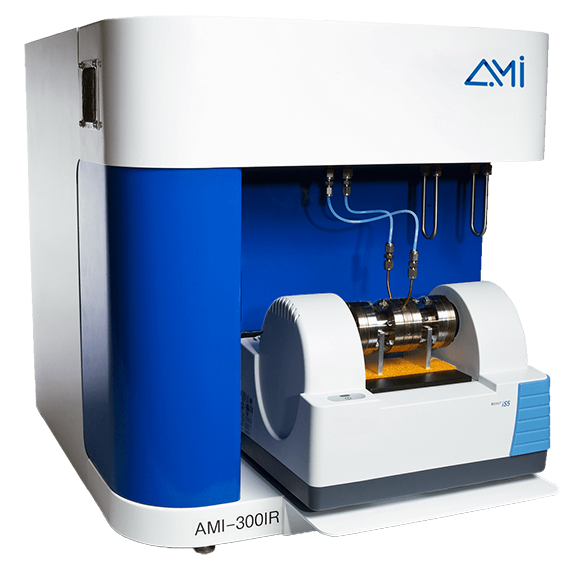
AMI-300 IR
Gases desorbed from a catalyst surface are commonly detected using a Thermal Conductivity Detector (TCD) or a Mass Spectrometer (MS). While these detection methods provide important information about the quantity and strength of active sites, they offer limited insight into the nature of these sites, the type of adsorption involved or the presence of multiple adsorption site types.
To overcome these limitations, the AMI-300 can be integrated with a Fourier Transform Infrared (FTIR) Spectrometer for in-situ, real-time monitoring of surface adsorbates during both adsorption and desorption processes. This powerful combination enables the detection of transient intermediates and reveals synergistic interactions between adsorption and surface reactions, offering valuable mechanistic insight.
A custom-designed heated IR transmission cell serves as the interface between the chemisorption system and the spectrometer. Catalyst powder is compressed into a thin wafer and placed within the IR cell, which is then heated as reactive gases flow through it. The gas-solid interactions are simultaneously monitored using the built-in TCD or optional MS, while the FTIR beam passes through the catalyst wafer for spectroscopic characterisation.
This setup allows for the distinction between Brønsted and Lewis acid sites during ammonia chemisorption, thereby enhancing the understanding of catalytic surface properties.
AMI-300 HP
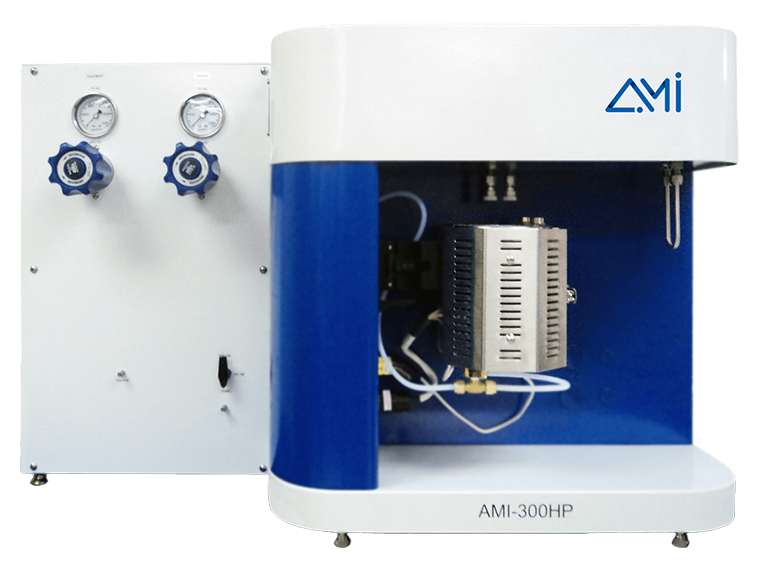
AMI-300 HP
The AMI-300 HP is designed to perform dynamic temperature-programmed experiments at pressures ranging from atmospheric up to 100 bar, enabling comprehensive studies of catalyst behaviour under industrially relevant conditions.
In addition to its chemisorption capabilities, the AMI-300 HP can be configured to operate as a high-pressure gas-phase reactor. This dual-functionality provides a versatile, integrated platform for both catalyst characterisation and reaction testing—ideal for laboratories focused on catalyst performance evaluation, process development and kinetic modelling.
For applications involving volatile reactants, an optional vapour generation module is available, allowing precise dosing of vapour-phase compounds into the reactor.
Due to the highly corrosive nature of these compounds, specialised materials are required in the construction of test equipment to ensure system integrity and longevity.
The AMI-300S addresses these challenges by incorporating high-performance sealing materials, such as Kalrez and PTFE, which offer excellent chemical resistance. Additionally, the system can be supplied with corrosion-resistant surface passivated treatments such as Sulfinert® or SilcoNert® coatings on stainless steel components.
These inert, temperature-stable coatings provide robust protection against H₂S and other aggressive chemicals. The unit also features a glass-lined stainless steel feed line specifically designed for the safe and reliable delivery of sulphur-containing reactants to the catalyst bed.
AMI-300S
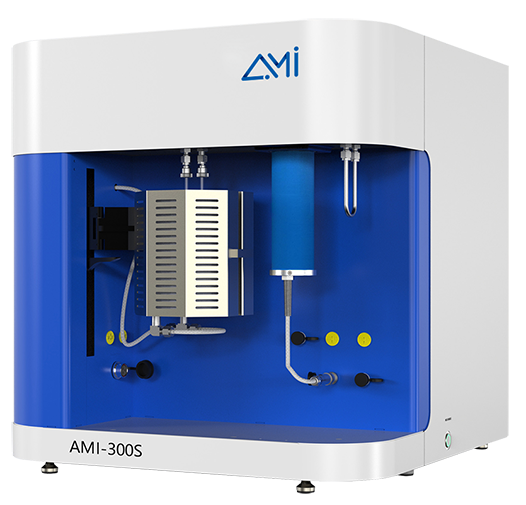
AMI-300S
Many important catalytic processes involve the use or generation of acidic and corrosive compounds. In the petroleum industry, for instance, catalysts are commonly employed for the desulphurisation of raw materials.
One such process is hydrodesulphurisation (HDS), a catalytic method used to remove sulphur (S) from natural gas and refined petroleum products.
Sulphur compounds are typically present in the form of hydrogen sulphide (H₂S), but can also include mercaptans, sulphides, disulphides, and thiophenes. These sulphur-containing species are major contributors to corrosion in testing systems.
Other corrosive by-products, such as sulphur trioxide (SO₃) and sulphur dioxide (SO₂), may also be encountered.
Halogenated compounds, particularly halides, present similar challenges. For example, the catalytic oxidation of halogenated volatile organic compounds (VOCs) in waste streams is a promising approach for hazardous material disposal. However, such studies are often limited by the material compatibility of test systems operating under harsh chemical environments.
Due to the highly corrosive nature of these compounds, specialised materials are required in the construction of test equipment to ensure system integrity and longevity.
The AMI-300S addresses these challenges by incorporating high-performance sealing materials, such as Kalrez and PTFE, which offer excellent chemical resistance. Additionally, the system can be supplied with corrosion-resistant surface passivated treatments such as Sulfinert® or SilcoNert® coatings on stainless steel components.
These inert, temperature-stable coatings provide robust protection against H₂S and other aggressive chemicals. The unit also features a glass-lined stainless steel feed line specifically designed for the safe and reliable delivery of sulphur-containing reactants to the catalyst bed.